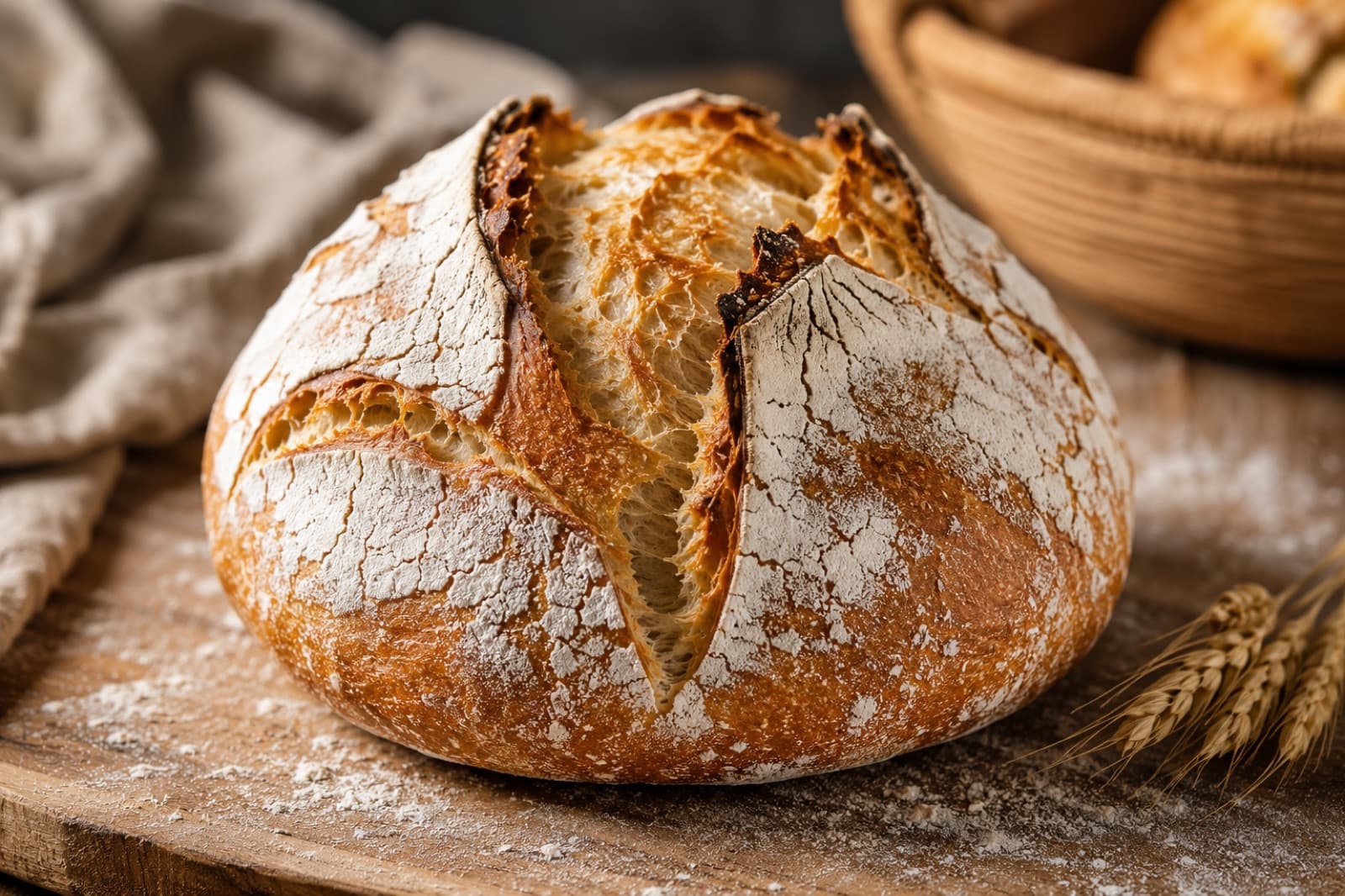
Tartine-Style Country Loaf
A rustic boule with a deeply caramelized crust and a tender, open interior. This recipe is a Sarah's kitchen staple — reliable, repeatable, and forgiving of small mistakes.
I bake a country loaf almost every week. It's the one I learned on, the one I troubleshooted my way through, and the one I keep coming back to. The recipe below is the version that finally clicked for me — patient bulk, confident shape, hot Dutch oven.
Ingredients
Dough
- 500g bread flour
- 350g water (70% hydration)
- 10g fine sea salt
- 100g active sourdough starter (levain)
Method
- 1
Feed your starter
8–12 hours before mixing, refresh your starter so it doubles by the time you mix. A ripe, bubbly levain is non-negotiable for good rise.
- 2
Autolyse
Combine flour and water (hold back ~25g for the salt). Cover and rest 30–60 minutes so the flour fully hydrates.
- 3
Mix and rest
Add the levain and salt with the reserved water. Pinch and fold until smooth. Rest 30 minutes.
- 4
Bulk fermentation
Over 4–5 hours at 75°F, perform four sets of stretch-and-folds at 30-minute intervals. The dough is ready when it's smooth, jiggly, and 30–50% larger.
- 5
Shape
Pre-shape into a loose round, rest 20 minutes, then final-shape into a boule or batard. Place seam-up in a floured banneton.
- 6
Cold proof
Refrigerate 12–24 hours. The cold develops flavor and makes scoring easier.
- 7
Bake
Preheat a Dutch oven at 500°F for one hour. Turn the loaf out, score, and bake covered for 20 minutes, then uncovered at 450°F for 20–25 minutes until deeply browned.
Sarah's Tips
- Use a kitchen scale — volume measurements lie.
- Build your levain at 80–85% hydration for predictable timing.
- The poke test isn't gospel. Watch the dough's jiggle and rise instead.
Substitutions
Not everything has to come from the recipe list. Here's what swaps cleanly and what to watch for when you make a change.
All-purpose flour will work in a pinch — expect a slightly tighter crumb and lower oven spring. Drop hydration by 3% if the dough feels wet.
Milk for a softer, sweeter crumb. Replace 1:1, but reduce by 5% (milk's milk-solids tighten the dough). The crust browns faster — drop oven temp by 25°F.
If yours is on the weak side, increase to 25% of flour weight and extend bulk by 1 hour. If it's roaring, drop to 15% and watch carefully.
What can go wrong
Every bake fails differently. Here are the three problems most likely to show up on this recipe — and how to recover.
Dense, gummy crumb
Almost always under-fermented bulk or a young starter. Bulk longer, until dough has risen 50% and feels pillowy. Float-test your starter before mixing.
Flat, pancake-shaped loaf
Over-fermented bulk or a too-loose final shape. Watch for the dough to stop holding its shape during bulk — that's the cutoff. Tighten your final shape with a bench scraper.
Pale, soft crust
Oven not hot enough or no steam. Preheat the Dutch oven for a full hour at 500°F. The first 20 minutes covered is what builds the crust.
Trouble with the starter itself? Read the troubleshooting library →
Variations to try
Once you've baked the base recipe a few times, these are the riffs worth chasing.
- Shape as a batard (oblong) instead of a boule for easier slicing and longer sandwiches.
- Bake at higher hydration (80%) for a more open crumb. Drop to 70% for a tighter, sandwich-style loaf.
- Add a roasted-garlic confit fold at the third stretch-and-fold for a savory twist.
- Brush with olive oil and crack sea salt during the last 5 minutes of baking for a focaccia-like crust.
Frequently asked
Can I bake this without a Dutch oven?
Yes. Use a sheet pan plus a tray of boiling water on the rack below for steam. Crust won't be quite as dramatic, but it'll be very close. Cover with a metal bowl for the first 20 minutes for the best result.
What's the best flour to use?
Any bread flour with at least 12% protein. King Arthur Bread Flour and Bob's Red Mill Artisan Bread Flour are reliable. Avoid all-purpose unless you're substituting in a pinch — the resulting crumb is tighter.
How long can I cold-proof this loaf?
12–48 hours. Sweet spot is around 18–24 hours for flavor and ease of scoring. Past 48 hours, the dough starts to over-acidify and lose oven spring.
Can I freeze the dough?
Yes. After shaping, freeze the loaf wrapped tightly. Defrost in the fridge overnight, then proof at room temp for 1–2 hours before baking as usual.
Take this recipe anywhere.
Download a portable .sourdoughrecipefile — the full ingredient list, every method step, your scaling, all packed into a few kilobytes. Open it in the Sarah's Sourdough iOS app, edit it, AirDrop it to a friend who bakes. The recipe travels with you.
Bake this with timers, scaling, and peak alerts.
Step-by-step timers that pause when you do. Dough-weight scaling rewrites every gram. Peak detection so you mix at the right moment. Log the bake when you're done.
No subscription. No ads. Yours forever.
You might also like
Pane casareccio, the everyday Italian table loaf. Olive oil welcome.
Maple-water hydration and a hint of whole wheat. Pure New England comfort.
A round, open-crumb loaf that's the perfect first project for any home baker.