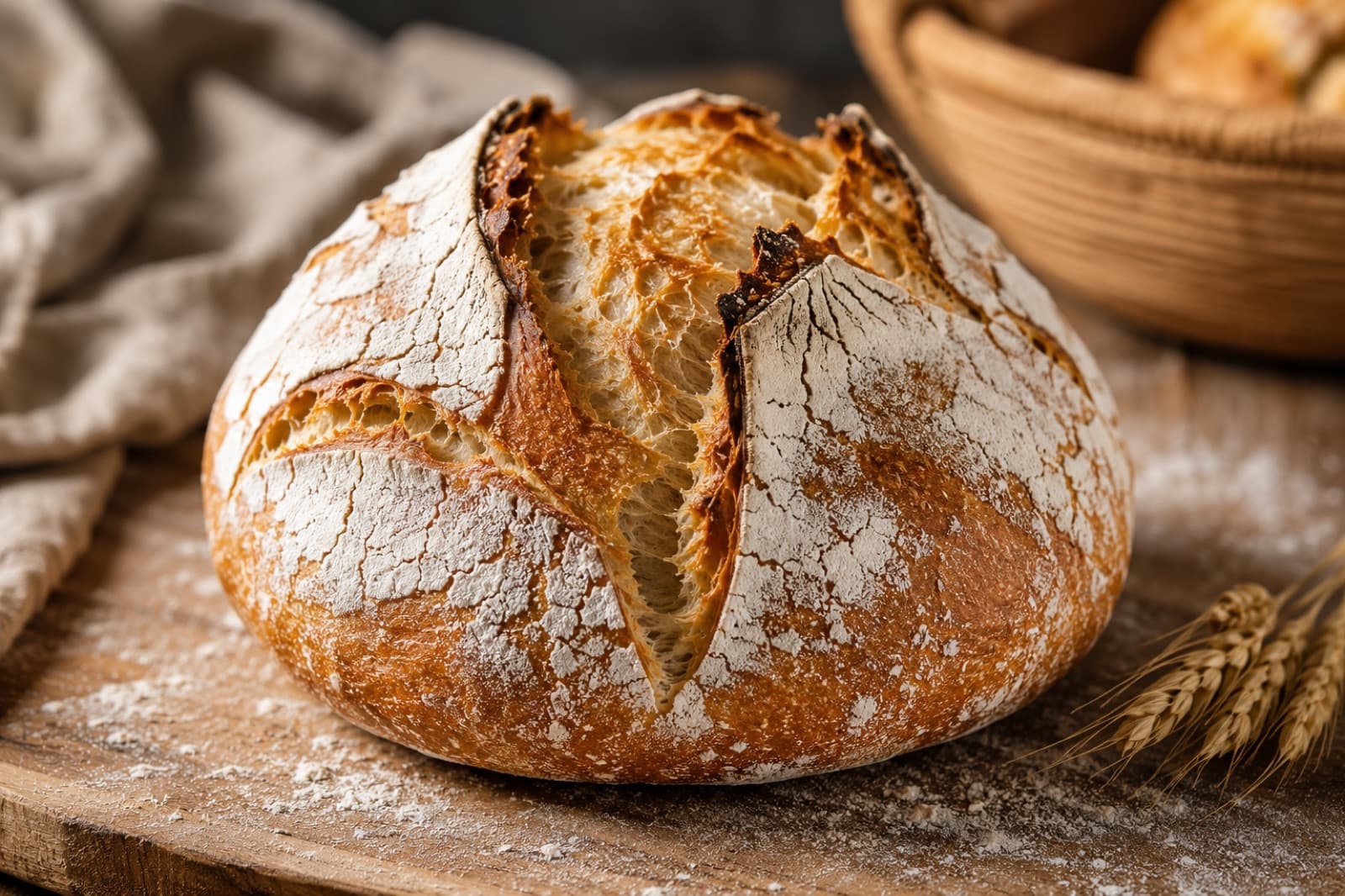
Sourdough Hamburger Buns
Sturdy, slightly sweet buns that won't fall apart on a juicy burger. This recipe is a Sarah's kitchen staple — reliable, repeatable, and forgiving of small mistakes.
Specialty breads are the ones that look impossible until you do them once. Bagels in particular taught me to trust the boil-then-bake instinct. Sourdough specialties are the same — they reward following the steps in order.
Ingredients
Dough
- 500g bread flour
- 300g water (60% hydration for bagels, higher for ciabatta)
- 10g fine sea salt
- 100g active starter
- Optional: 20g malt syrup or honey
Method
- 1
Feed your starter
8–12 hours before mixing, refresh your starter so it doubles by the time you mix. A ripe, bubbly levain is non-negotiable for good rise.
- 2
Autolyse
Combine flour and water (hold back ~25g for the salt). Cover and rest 30–60 minutes so the flour fully hydrates.
- 3
Mix and rest
Add the levain and salt with the reserved water. Pinch and fold until smooth. Rest 30 minutes.
- 4
Bulk fermentation
Over 4–5 hours at 75°F, perform four sets of stretch-and-folds at 30-minute intervals. The dough is ready when it's smooth, jiggly, and 30–50% larger.
- 5
Shape
Pre-shape into a loose round, rest 20 minutes, then final-shape into a boule or batard. Place seam-up in a floured banneton.
- 6
Cold proof
Refrigerate 12–24 hours. The cold develops flavor and makes scoring easier.
- 7
Bake
Preheat a Dutch oven at 500°F for one hour. Turn the loaf out, score, and bake covered for 20 minutes, then uncovered at 450°F for 20–25 minutes until deeply browned.
Sarah's Tips
- Boiled doughs (bagels, pretzels) need a confident, brief bath — 30 seconds per side.
- Steam is your friend for crusty European-style loaves.
- Tangzhong (cooked flour paste) is the secret to ultra-soft milk breads.
Substitutions
Not everything has to come from the recipe list. Here's what swaps cleanly and what to watch for when you make a change.
Different specialties want different flours. Bagels love high-protein bread flour (12%+). Ciabatta wants 00 or a high-extraction blend.
Optional but helps boiled doughs (bagels, pretzels) brown. Honey or molasses substitutes 1:1.
What can go wrong
Every bake fails differently. Here are the three problems most likely to show up on this recipe — and how to recover.
Bagels look wrinkled after baking
Don't overproof before boiling. The float-test (a bagel should float when ready) catches this. Boil for exactly 30 seconds per side.
Pretzels are pale
The lye or baking-soda bath needs to be strong enough. For baking soda: simmer 1L water with 3 tbsp baking soda for 3 minutes. Don't substitute baking powder.
Baguettes don't open up
Score parallel to the long axis, not perpendicular. Cuts should be shallow (½ inch) and overlap slightly to create the characteristic ear.
Trouble with the starter itself? Read the troubleshooting library →
Variations to try
Once you've baked the base recipe a few times, these are the riffs worth chasing.
- For bagels, try a longer cold proof (36 hours) — the chew gets noticeably better.
- For ciabatta, switch to a 100% biga preferment instead of the standard levain for a more open crumb.
- For English muffins, cook on a cast-iron griddle at 325°F for the proper nooks-and-crannies bottom.
Frequently asked
What makes specialty doughs different?
Specialty doughs (bagels, pretzels, baguettes) usually involve a high-temperature pre-treatment — boiling, lye-bath, or extended steam — that drives the unique crust. Skip that step and you've got bread, not the specialty.
Can I substitute baker's yeast for the sourdough?
Yes, in a pinch. Use 2g instant yeast per 500g flour and cut total time roughly in half. Flavor will be milder.
Take this recipe anywhere.
Download a portable .sourdoughrecipefile — the full ingredient list, every method step, your scaling, all packed into a few kilobytes. Open it in the Sarah's Sourdough iOS app, edit it, AirDrop it to a friend who bakes. The recipe travels with you.
Bake this with timers, scaling, and peak alerts.
Step-by-step timers that pause when you do. Dough-weight scaling rewrites every gram. Peak detection so you mix at the right moment. Log the bake when you're done.
No subscription. No ads. Yours forever.